
Saturday, June 8, 2013

Southern Open on Coosa River


The third Bassmaster Southern Open tournament of 2013 was held on Alabama's Logan Martin in Pell City. It was a another amazing event with water levels constantly changing.  Wow, were Coosa River spotted bass fun to catch!
Photo by BASS: James Overstreet
I missed several opportunities to do better during this event and it cost me with a 120th place finish.  Despite the poor showing, I still had the best season of my career. While not satisfied with my performance this year, I will accept the fact that 2013 was the pinnacle of my professional bass fishing career.  

Here is how Logan Martin fished:
Heavy rains during the weeks leading up to the tournament brought the water up six-feet above full pool. My initial campground was under water when I arrived on Sunday for my first day of practice so I had to scrabble and find another campground. I've learned to keep a list of all the local campgrounds and hotels for just such an emergency.  
With the high water brought muddy conditions and lots of floating debris.  The bass were trying to spawn in the 68F degree water temperatures and spawning beds were common in the shallow, backwater areas.  Largemouth bass were easily located in water two feet deep along the shorelines of coves using topwater, spinnerbaits, and soft plastic creature baits.


Aquatic vegetation grew along the shorelines and submersed plants grew in the quite coves of several creeks. Still, largemouth bass over four pounds proved to be elusive and not feeding well.

Spotted bass were doing what they do, schooling along main points of the Coosa River and in coves.  Topwater, jerkbaits, and crankbaits got plenty of bites during practice from one pound spots.
Coosa River spotted bass (Micropterus punctulatus)

Typical schools of bass fry in the shallow water creeks
By Wednesday I had two areas that held good bass, Rabbit Cove and Clearwater Creek.  They were a fifteen minute run from the launch site so I needed an early boat draw to allow me to reach my fish before the other anglers. As luck would have it, my boat number for day one was 38.

My practice weather had sunny and light winds so on tournament day it was, obviously, it was overcast.  The water management agency had lowered the lake about one foot overnight in anticipation for rain. I was able to overcome the weather change but the lower water started re-positioning the shad.  The spotted bass were roaming more over deep water (40ft) and not bunched as much up on points.  I found a good cadence for my jerkbait that caught several spots, just no big ones.  With no keepers in my livewell by mid-morning, I made a move to fish for shallow-water largemouth bass.

I motored to my best creek and quickly caught three keepers on a speed worm.  Water that was once three feet deep in practice was now only two feet deep.  While the overcast conditions kept the bass shallow, the fish instinctively knew to swim to deeper water to avoid being left stranded on dry ground. In addition, a local angler was enjoying a day of bass fishing and was doing a real good job of catching all the bass I located. So much for un-pressured fish...but wait...I saw a bass chasing bait shallow.  I threw a soft plastic fluke to the where the bait fish were jumping and a good bass eats the lure in one foot of water.  I set the hook but the plastic balled up on the hook and prevented me from getting a good hook set.  I quickly picked up my xrap hard jerkbait with three treble hooks and work the area.  Just when I was about to lift the lure out of the water for another cast, a largemouth bass about four pounds hits my lure.  I immediately noticed it hit the last hook, and just barely at that. I gently tried to play the fish but the skin-hooked bass easily surged and got away. Ouch, I knew that was going to cost me in this event.

By noon I had enough of the shallow water and decided to spend the rest of the day in deep water trying to catch the three pound spotted bass I had found in practice.  The first pass on my main point in Rabbit Cove produced two nice keeper Coosa spots that gave me my limit.  While a limit felt good, I was targeting larger bass and thought of my small limit as only by-catch.
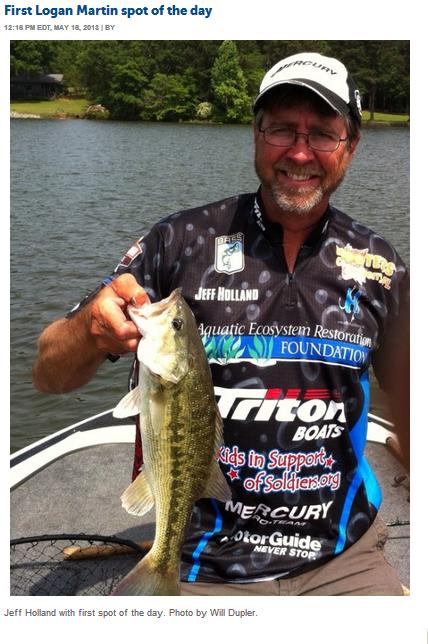
Live blog post on Bassmaster.com 
BASS was testing out a new blog during the Open events, so my co-angler snapped a picture of my first Coosa spot in the tournament for the live blog.

I culled by ounces the rest of the day and ended with a total of five bass weighing 8.4 pounds, good for 119th place (out of 164).  I was miserable.  The four-pound bass I lost would have put me in the top 50.

BASS tournament organizers flip boat numbers on the second day to make it fair to everyone.  Since I launched early on day one, I could expect to launch late on day two.  My number ended up being boat 127, in the 9th flight.  But that wasn't the bad part of the day.  The bad part was the water was down nearly two feet overnight due to heavy rains expected in the evening of day two. That was going to hurt my shallow water bite.

I ran to the deeper spotted bass points to try and get an early bite while the water was flowing.  Spotted bass were eating, and I had a small limit within the hour on my jerkbait.  Thinking I need big largemouth bass to climb up in the standings, I moved back into my shallow water creek.  The fish had left, and I didn't catch a single largemouth big enough to cull the spotted bass I had in my livewell.  Not having time to relocate the largemouth, I started fishing every point for spotted bass on the way out of the creek. I was rewarded with a nice 2.5 pound spotted bass and a few two pounders.  Still, I knew my small limit would not help.  I fished as hard as I could trying to relocate the shad and my three pound spots but I never did.

In hind sight, the items I did not fish in my cove were two marinas.  And wouldn't you know it, the eventual winner of the event, David Kilgore, found his bass feeding on shad that have moved to those marinas.  The overcast apparently put the shad in the mood to spawn, and the only thing in the cove to spawn on was the floating docks.  I learned a valuable lesson.

My second day ended with almost the exact same weight for five fish, 8.5 lbs. The 120th place I earned was the worst of my season and pulled my overall Angler-of-the-Year (AOY) ranking from 12th to 28th. When I get focused in my tournament mindset, nothing but a win is acceptable, and I was very disappointed while driving back to Florida and reflecting on my performance.  I continue to achieve my goal of improving my fishing skills, but that does not remove the sting of knowing that I could have done better.

Now that the event is over and I had time to put it into perspective, I feel proud about a 28th AOY finish in the Southern Open level of the Bassmasters tournament trail!


I learned a lot this year and beat some prominent Elite tour professionals along the way. I walked away from the Alabama event with the best fishing season of my professional career and I already look forward to starting the 2014 season.  

Thanks for following my blog and please support our troops by helping out Kids in Support of Soldiers

Jeff


Sunday, April 21, 2013

My Southern Open Recap on Douglas Lake TN


My learning curve grew exponentially during the 2013 BassmasterSouthern Open on Douglas Lake in Dandridge, TN.  

While I finished in 22nd place and moved into 12th place for Angler of the Year points, it was by no means an easy event.  I never found out how to catch them good using the umbrella rig so I relied on a jig fishing pre-spawn pattern.


To compete at this event we had to overcome severe conditions of both heavy fishing pressure and brutally-cold weather.  The week before our event nearly 400 anglers attacked Douglas Lake in a PAA tournament event.  That week-long derby was faced with snow and cold weather that lowered the water temperature back into the low 50s. The Tennessee umbrella rig (3-hook version) dominated that PAA event and the Southern Open anglers were frothing the water with umbrella rigs during practice.   That additional fishing pressure caused the bass to avoid the standard umbrella-rig technique.  It was not until after the event that I learned how the leaders were slow rolling the TN-rig to entice big bass.  


Douglas Lake fluctuates 40-ft in a season
Water rose 4.5 ft since I arrived

My 2013 schedule only provided me with two and a half days of practice time, so I limited myself to my best lures using my best techniques. After two days of practicing on Douglas Lake I only caught one largemouth bass at the end of the second day.  

The main lake water was 50-52F degrees and stained with a green tint. Two cold fronts had dropped the water temperature to a range that caused a massive threadfin and gizzard shad die-off.  I matched my lures to the bait size and colors, but all the predatory fish in the lake we gorging on dead shad as easy as picking grapes off a vine.   
Threadfin shad and my TN-umbrella rig to match
my spinnerbait closely matched the Gizzard shad

TN-rig caught white bass only for me
In practice I found white bass were bunched up along rock bluffs up river with deep water nearby.  I figured that largemouth had to be nearby, so I used a jig to work the rock bluff.  I caught one 2-pound bass just before my practice day ended on Tuesday.  The next day I fishing rock bluffs with my jig and caught a quick limit of bass.   At that point I knew I found a place and pattern to start the tournament on, but I knew that small limits would not compete with the leaders.  Unfortunately, I was out of time and stuck “with the cards I was dealt.” I felt I was forced to develop a stronger fishing pattern on the first day of the tournament, something every angler dreads.


Sunny weather in practice turned cold and wet during the event

Air temperature in the 30's created ice on boat decks

Not fun watching 174 boats launch ahead of you but that was my luck of the draw on day one
Did I mention the weather?  There was a warming trend in our practice that quickly dissipated when a clash of air masses brought a rainy, cold forecast for the tournament days.  We woke on the first day of the tournament with air temperatures in the 30s and a light coating of ice on the boats.  As boat #175, I didn’t launch out until 7:20am and reached my first spot up river by 8:00am.  On my first pass along the bluff wall I  quickly caught I small limit of bass before the rain started.  Then the wind blew 15mph out of the North and rain came down steady the entire day.  

The bone-chilling conditions reminded me of a Marine training boot camp.  The physical and mental processes of trying to focus and function when you are shivering, soaking wet, and cold, are the most challenging conditions for the human body to withstand.  My leg would shake every time I ran the trolling motor, my back muscles would lock up on every other casts, I couldn’t feel my toes, and tying knots as an eight minute process.  I shivered for nearly seven hours but I was able to survive the conditions by focusing on one task at a time and blocking out the cold.  Not something I enjoyed, however, I came off the water knowing that I was mentally capable of overcoming my physical environment.  The confidence I gained was invaluable!   

Anyone that knows me knows that I absolutely hate cold weather and being cold.  In a bass boat there is no where to warm up once you are wet.  My mental exercises kept me in the game and allowed me to catch a small limit of largemouth that weighted 12-7 pounds, good for 37th place on day-one.   

Small limit of bass the first day held me in 37th place

Cold, muddy water moved in
As if there weren’t enough environmental challenges on the first day, I found totally different fishing conditions on the second day. When I arrived on my spot the next morning I was faced with water levels that raised two feet, high current flow, and cold muddy water that the rain washed in.  I fished my rock bluff for two entire passes without a bite.  I had no other fish to go to, so I was forced to figure out the bass and fish this area regardless of the fast flow and 48 degree muddy water. 


I knew the high current would place the bass tighter to the rocks so I concentrated on pin-point casts. It worked, and the first bass I landed on day-two was a little over four-pounds.  Then I proceeded to catch one or two bass every time I fished down my rock bluff.  

Bass Photographer James Overstreet captured the moment!
At the end of the day I caught a limit weighing 13-1 pounds, just ounces heavier than the previous tournament day.  My final weight was 25.8 lbs and nothing near the top leader weights, yet I was excited to see that my weight earned 22nd place and a pay check under extremely the tough fishing conditions.  My first pay check on the Bassmaster Southern Open level and I stood shoulder to shoulder with Rick Clunn,  only loosing to him by one place!

The points I earned for the year put me in 12th place for the Angler of the Year (AOY) race.  More than just bragging rights, the top five AOY-anglers earn an invitation to fish on the Bassmaster Elite tour, the most prestigious fishing series in the world!  What an honor that would be!
deep coves looked great but did not produce for me
Rock bluffs were the best option I found during the muddy, rising water conditions

Looking back on the event the best thing I did was move away from the shad die off to areas where bass were still actively feeding and chasing bait.  With limited practice time it is extremely difficult to catch up with the knowledge that the local angler had about the lake.  The ecosystem and habitat of each lake is unique, and understanding the dynamics is what drives me to compete at this level.  Fishing in lakes that lack aquatic plants makes me understand why anglers say bass are easier to pattern on Northern lakes.  I am finding that when a lake only contains wood, rocks, and structure drops, it seems to be easier to figure out the local fishing pattern. That kind of habitat is what I term “simple habitat”.  The more I fish the Bassmaster Southern Open trail the more I appreciate the “complex habitat” that aquatic plants add to lake ecosystems like Florida.

When I returned to sunny Florida I took a day to fish with my son-in-law Ryan on the St. Johns River.  The bass were in a spawn/post-spawn mood and we had a great time landing big bass.

Largemouth bass on St. Johns River in sunny Florida
My Son-in-law Ryan beats me with a bigger bass!

My schedule has me fishing the Florida BASS Nation State qualifier on Lake Toho May 4th,


then heading up to the Coosa River / Logan Martin system in Pell City, AL May 12-18th to fish the last Southern Open event for 2013.


I can’t wait to get to Alabama and catch a ton of spotted bass!    
Jeff

Friday, March 29, 2013

Bassmaster Elite Pros Top the Field at Douglas Lake


I am very proud to be a life-time member of the Bass Anglers Sportsman Society (BASS), and extremely proud that BASS Elite Pros top the field on Day 1 at the Professional Anglers Association (PAA) tournament on Lake Douglas. The PAA tournament attracts the best pros of all tournament trails, and the fact the BASS Elite pros were on top supports the well known notion that BASS is the best in the business! 
As I finish my packing for my trip to Dandridge, TN  to fish Lake Douglas TN in the Bassmaster Southern Open #2,  I continue to check on lake conditions and the results of the on-going PAA event.  The water level is down about 25ft, but the lake is fishing good.  Many limits of bass were weighed-in yeasterday in the PAA event and a good number of five-pound average stringers. 
BASS Elite Pro Guy Eaker fishing Lake Douglas (Photo by FishPAA.com)
As 150 anglers ascend on Lake Douglas this week, and another 200 anglers arrive over the weekend for the Bassmaster Southern Open event, the bass fishing is expected to get tough.  The good news is that a warming trend is predicted to hit over the weekend and hopefully it will refresh the bass and get them actively feeding despite all the fishing pressure.
I'm ready to test my fishing ability as well as mental skills against a species of fish that is extremely attuned to its aquatic environment.  With sound traveling 4 times faster in water, Lake Douglas bass will know I'm coming before I ever make a cast.  Still, they are fish, with a tick for reflex striking, something I hope to exploit as part of my game plan.  
I want to thank Millers Boating Center, Triton Boats, Mercury Marine, and Power-pole for their continued support and I hope to represent them strong in this next event.  AERF, Casselberry Hooters, and Kids-In-Support-Of-Soldiers continue to be the backbone of my angling career and I always represent them proudly in my events. 
If pre-tournament excitement earned you a paycheck, I would be rolling in the money right now!              

Jeff

Saturday, February 16, 2013

Beginning A New Tour Season 2013


The City of Kissimmee hosted the first Bassmaster Southern Open event of 2013 on Lake Tohopekaliga.  I must say it was nice to spend nights at home since the lake was in my home town only 45 minutes away. Still practice was typical for February in Florida with bass spawning and windy cold fronts hitting every few weeks to challenge the anglers. FWC plant management efforts were providing anglers miles of hydrilla edges to fish throughout the chain. 

Nearly 200 pro bass anglers visited Kissimmee Florida for practice on Monday and a shot at winning a berth to the Bassmaster Classic.  Both Monday and Tuesday practice days held nice weather, partly sunny cloud cover and a mild February breeze out of the north.  Then Mother Nature realized this was the first tournament of the year and she wanted to remind everyone who was boss. She hit the area with Gail force winds over 32mph from the South none the less.  Extremely unusual for the month of February.  Needless to say, the winds muddied up a lot of water the night before the tournament, leaving many anglers unsure of whether they had areas to fish on day 1 or not.


My name was randomly drawn as boat #31 on Day 1, flight #2 with a weigh-in time of 3:15pm.  This meant the early morning bite that I had discovered in practice had a chance to help me as it was in a wind protected area.  Luckily the area held up and produced two nice keepers in the first 45 minutes while the tournament director was still launching out the other anglers one at a time.  No more old fashion shot-gun starts like in the 80s.

The four pound bass I had found in practice had vacated the area and I probably spent too much of my morning searching for them.  As the sun peaked higher in the horizon I headed over to some shallower spawning areas and used a soft swimbait to pick up my limit by 10:30 am.  One of my personal goals of catching a five-fish limit of bass was accomplished, but I was still short of my other goal of having fish that averaged over three pounds. My research had shown that fifteen pound limits each day would give an angler a top 20 fish on Lake Toho, while an eighteen pound limit each day would make the third day’s cut of the top 12 anglers. 


Fishing the 2012 tour taught me that a small limit of bass only makes an angler feel good, it does nothing to help in the tour standings. To be successful on this tour, anglers must have larger than average bass and a big bass each day.  Knowing this I spent the afternoon chasing the ghosts of big bass I had found in practice.  Over 30% of the water I practiced on was muddied by the unusual Gail force winds. I was able to get two good bites flipping, one four pound bass I pulled to the surface of a cattail mat before it came off, and the other I lost when my braided line slipped out the eye of my flipping hook, another rare occurrence.  All the other big bass I had found under floating plant mats either scattered or were not biting.  The sport of fishing is very hard when you can’t see your targets, e.g. bass.  Imagine shooting basketball in a room with an invisible hoop that only showed up when you made a basket!  That’s bass fishing.  There could be 40 bass under a floating island and if you don’t entice them to bite a hunk of metal and plastic, things we call fishing lures, then you don’t even know they are there.   

My first day's limit of five bass weighed 9lbs 9ozs, averaging only 1.91 lbs/bass which put me in 53rd place.
 photo by James Overstreet, BASS

On day 2, I was drawn as boat #168, flight 9 with a 5:00 pm weigh-in time.  This late draw was going to prove beneficial as the bass were getting more active in the afternoons when the sun was high.  With an over night cold front dropping air temperatures down to 36 degrees F, I was going to need that sun to get my bigger bass active again.  I launched out in the morning with hopes that the cold front would improve my flipping bite again.

I started day 2 in the same early morning area as day one, got two nice keepers on a jerkbait, a dozen short bass, and then a nice three pound fish.  I flipped the mats around this area to no avail.  Next, I ran the same stretch of spawning flats in Lake Toho and finished out my limit by 11:00 am.  With a limit in hand I ran to south Toho and pitched floating hydrilla mats to cull up with another nice three pound bass.  On my next pitch I lost a good bass of nearly four pounds. I spent the next four hours pitching and flipping mats trying to catch a big bass but all I could do was upgrade my limit by ounces.   I found the big bass were no longer under my mats, but my stubbornness kept me wishing instead of fishing.   I picked up my jerkbait and starting working a little deeper water around my areas and again picked up a half dozen bass that only gained me ounces. 
    
With twenty minutes left until weigh-in, I made a cast next to some spatterdock lilypads. I ripped that jerkbait past the pads and enticed a reaction strike from a bass.  My line jumped, so I swept the rod to my right side to set the hook.  It was then that I saw the bass, a solid six pounder!  When I set the hook it turned her sideways to me and I could see she hit the jerkbait in the middle, with only one treble hook having a chance to hook her.  That chance was slim, and when she opened her mouth out came my bait.  I made many more pitches in the area knowing she never really got hooked, but I never could entice her to bite again.  I fished down the bank and nailed another solid three pound bass, culled up a few ounces, then headed to weigh-in.

My second day weight of 10lbs, 14ozs put me in 45th place overall; 10 ounces sky of making a paycheck, 5.5 lbs out of the top 20 list, and only 7.2 lbs out of the top 12 cut to fish the third day.  The lost four pound bass on day one and lost six pound bass on day two would have pushed me way up the leader board and given me the dream of fishing on the third day. 

So there you have it, my best finish, yet the worst tournament execution of my professional fishing career.  The yin and yang of fishing.  I felt good about finding the fish it took to win, just could not get them in the boat.  I can’t wait to try it all over again in April on Lake Douglas in Jefferson County, Dandridge, TN. 

Thursday, January 24, 2013

2013 Kissimmee Hydrilla and Lake Maps Now Available!


Map of abundance and location of hydrilla on Lake Kissimmee


Reduced-risk Herbicides & More Access to Maps

Most recreational users of our nation’s lakes admit that invasive plants and animals cause problems.  These accidental invaders infest our waterbodies, often clogging waterways and impacting the balance of the ecosystems. 
Hydrilla is one of those invaders, and widely managed because of its ability to overtake native plants at uncontrollable rates. 
Aquatic Ecosystem Restoration Foundation (AERF) and several natural resource agencies have been actively evaluating several new, reduced-risk herbicides.  The results are expected to help guide water resource managers for selective Hydrilla control in lakes, rivers, canals, and reservoirs.  By being plant-specific, these herbicides will continue to support past practices of managing invasive plants while limiting impacts on non-target plants. 
As part of the herbicide evaluation process, mapping techniques are being improved.  These techniques are allowing resource managers to gather faster and more detailed information on plant locations, effectiveness of controls, and overall biomass reduction rates.  This highly detailed process gives plant managers something they did not have in the past, a nearly precise measurement of plant control. 
One example is the work being conducted by the Fish andWildlife Conservation Commission and University of Florida.  They evaluated the submersed plant communities on the four main Kissimmee Chain lakes in January, 2013.  From this information they were able to gage the impacts and regrowth potential from previous hydrilla control efforts.  These details will help them better plan where future hydrilla management may be needed in spring of 2013. 
The submersed plant images are posted with bathymetric maps for each of the four lakes of the Kissimmee Chain on the UF / FWC website.  Navigate down the webpage and select the first letter of the lake you are interested in viewing.

Monday, January 14, 2013

Pre-practice Comes to a Close


Father Time caught up with me and I had to end my pre-practice session for 2013 on Kissimmee Chain of Lakes.  The past two months have been nice, allowing me time to examine the conditions of the lakes and moods of fish at a leisurely pace. Now it’s late January, and my tournament season is fast upon me.  The first event, Bassmaster Weekend Series, is scheduled on the Kissimmee Chain of Lakes in two weeks, immediately followed by the Bassmaster Southern Open event Jan 31-Feb 2.
   
The Kissimmee lakes are acting very typical, with bass in all three phases of spawning.  Professional anglers like Chris Lane are predicting good weightsWeed control efforts against the overgrowth of nuisance Hydrilla have taken affect.  Some lakes are fishing easy, giving up ten pounds limits within minutes, others were difficult at best.  The new lake maps that Florida's fish & wildlife agency has been placing on the Internet were very helpful to my practice.
Taking advice from Gary Klein I plan on fishing to my strengths.  That is, I plan on keeping a spinnerbait in my hand and slow rolling my bait through the deep, open waters of the chain.  Over the years I have been able to catch many bass six to nine pounds with this technique and for the Southern Opens I know that I have to concentrate on quality fish, not just limits. 

In pre-practice I had to slow down even more and occasionally cast a worm to a submersed plant bed to check if bass were present.  As you see, they were!
Kissimmee Chain of Lakes pre-practice bass, 2013

Monday, October 22, 2012

End of A Rookie Season


My largest tournament-weighed spotted bass (3.93lbs)
October 5, 2012 on Smith Lake, Alabama

While I was not new to fishing Bassmaster-sponsored tournament trails, I was new to the Bassmaster Southern Open trail in 2012, a trail which offered a level of competitive fishing like no other.  My final outcome was a 79th place finish in Angler of the Year points (top 32% of the field) and a decent year on the trail. 

In my first year on the tour we traveled from Florida, to North Carolina, to Alabama.  The types of lakes we fished ranged from southern grass lakes to upland reservoirs dominated by rocks and docks.  I traveled over 5,000 miles and provided my sponsors over one half-million impressions of their boat-wrap logos.  In addition, I was able to catch a limit a bass in all but one day of fishing, which allowed me to walk across the stage and be interviewed live on Bassmaster.com website. This brought another estimated quarter-million impressions to my sponsors.  Lastly, I was honored to be a guest speaker for AERF at the Bassmaster Federation Nation Conservation Directors meeting at the 2012 Bassmaster Classic in Shreveport, LA. 

Aquatic plant dominated lakes in the south


Rock dominated lakes in upland reservoirs
While I felt great about the ability to represent my sponsors, I did miss out on several key opportunities to finish better in the tournaments.  Reflecting back, I can list specific bass I missed because I made incorrect retrieve changes as they followed my baits, changes that caused them to shy away instead of hitting. In golf every putt counts, and similarly in fishing, every retrieve, twitch, or turn of the reel handle causes different reactions to the bait and determines whether or not a following-fish will hit.  The details of fishing are amazing and so important to the outcome.

Tuesday, August 21, 2012

Information Overload

It has been a while since my last post and I apologize to me followers.  I wrote several blogs but apparently never posted them.  While I continue to pursue my passion of knowledge, I've neglected my goal of sharing what I've learned.  Please accept my apology.

My second Bassmaster Southern Open event on Lake Norman in Charlotte, NC was amazing.  I caught 40-70 spotted bass a day in practice under sunny skies and calm weather.  What a fantastic fishery!  However, the tournament weather was rainy and overcast.  Fish changed and I failed to adapt.  Afterwards I learned the error of my ways.  I learned two valuable lessons that I wish to share:  1) spotted bass are very color-specific depending on the weather conditions,  2) the shakey-head worm is an amazing bait in reservoirs.

I finished just shy of the top-100 in that Southern Open event so I have a lot of work to do for the future.  I wrote a detailed summary and failed to post it but I will send it out as soon as I locate the file.

To get ready for the last Southern Open event on Lewis Smith Lake, AL, I've been working on tackle and techniques.  This is another amazing fishery with spotted bass and largemouth.  The water averages, get this, over 200 feet deep.  One of the clearest fisheries I've ever had the pleasure of fishing!  It is common to be casting a lure to the shoreline while your boat is sitting in over 90 feet of water!  Simply out of this world!

Mark my word, fishing technique, casting accuracy, and efficiency are going to win this upcoming event.The angler who can figure out the right lure/speed combination, be most efficient, and make accurate casts is going to win.  It's just that type of fishery where every ounce counts.

Look for my Smith Lake details very soon.  Thanks for joining me in my fishing adventures...
Jeff 

Wednesday, February 29, 2012

View of the Bassmaster Classic from Southern Open-Colored Glasses


This year I was able to attend the Bassmaster Classic and it was a great event and great to see Florida angler Chris Lane win.  But instead of viewing the event purely as a spectator, I actually had the feeling that I was taking a training class on how to act as a Classic angler.  You see, I am now fishing the Bassmaster Southern Opens, and each tournament I fish I will have a shot at winning an entry into the next Bassmaster Classic.
I watched the 2012 Classic anglers organize their equipment in their boats with the utmost efficiency.  In the Classic, time is extremely limited, so the better Classic contenders have learned not to waste one precious moment.  Disorganization can cost valuable time, maybe not the one time you have to search in your boat to find a bait, but add up all the times you had to search for baits in the tournament and it could mean the difference. 
I watched how the anglers expressed themselves, both with fans and when alone in their boats with their thoughts.  Focus was key, and even during press conferences each day I could see the top contenders processing and thinking about the words their fellow anglers were saying when questioned by the media. 
There are very few secrets in the Classic, and everyone knows what each angler is doing.  The media questions make the anglers reveal small pieces of information about the success each day.  Not enough information for the average angler to grasp, but enough tidbits for their competitors to pick up on.  For instance, I watched Alton Jones’s eye light up when day one leader Keith Poche answered media questions about his fishing area and how the bass were biting his baits.  While Keith never revealed the color or kind of baits he was using to take the lead on day one, he told enough to unknowingly help his competitors.  The next day Alton apparently used the information to his advantage and jumped up into 3rd place while Keith fell down the leaderboard.
I watched how the anglers managed spectator’s boats, who fished well in crowds of other anglers, and who ran away from the crowds to seek isolated fishing holes.  I learned first-hand in the Southern Opens that once you achieve a boat wrap, other anglers will follow you more, mark your fishing areas, and take notice of the lures you are using.  To excel at the level needed to fish professionally anglers have to be able to handle crowds and recognition.  

The message is clear, to be successful you must be able to use ordinary lures in magical ways, not rely on secret fishing hole or secret lures.  Understanding how bass react to presentations and lure techniques becomes the focus of Elite anglers.  Every one of the Bassmaster Classic anglers were using fishing rods, reels, lines, and lures that everyday anglers can purchase and use. 
The Bassmaster Classic is truly as sport where knowledge and experience win.

Sunday, January 29, 2012

Handling Misfortune

My big chance to finish high in the Bassmaster Southern Open tournament was lost when random misfortunes caused a shortened tournament day.
After six weeks of scouting the Harris Chain of Lakes and finding bass holding in a pre-spawn stage, I just knew that I had a mid-depth fishing pattern that would allow me to catch enough bass to place well in the event. 
My pre-tournament preparation began with maintenance items being checked off and completed, rods rigged and baits carefully tied.  I had a solid state of mind and a series of game plans depending on the weather and my boat number.  I was relaxed at the partner pairing meeting and felt in control of my destiny.
On the first day of the tournament I launched out as boat number 175, so when I motored into a my small cove it surprised me that I had the area all to myself.   The other 196 competitors overlooked my fish I knew I was onto a solid winning pattern.  I fished the area and caught a nice little limit of bass that weighed 10.10 pounds.  It was under my goal of 13 pounds but solid enough to place me in 53rd place. 
On day two I was boat 24 and with an early start I was going to fish my best spot in another lake where I had found an abundance of larger bass.  I figured I needed about 15 pounds to make the third day cut of top-12 anglers; which should have been an easy task given the conditions and the pre-spawn group of bass I had located. 
Lady Misfortune had another idea for me and I never made it to my primary fishing area.  Something on my outboard motor broke first thing in the morning.  It was a random mechanical failure that could not have been prevented and I was forced to fish around the launch ramp on my trolling motor. 
My plan to reach my fishing spots and my dreams of earning a large paycheck vanished.  To say I was disappointed would be an under statement.  Yet, I still felt in control of my destiny and remained in a positive frame of mind.  I used my Bass Pro Shops AGM gel-cell batteries and Motorguide Tour Edition trolling motor to fish through 15 mph winds and catch two more bass.   
Even though I lost the tournament, I ended up earning 105 points for a 93rd place finish. I beat over 50% of the field which included several well known professional Elite BASS anglers.  All in all, not a bad finish given my misfortunes.
I was proud that I never lost my temper or got discouraged. During my downtime on the last day I had a chance to meet with many of my product representatives, and the seeds of friendship planted that day have already begun to grow.  I look forward to a great year on the Bassmaster Southern Open trail in 2012!