Showing posts with label biology. Show all posts

Wednesday, January 11, 2023

Learning Your Aquatic Plants to Catch More Fish

The world of aquatic plants is vast and diverse.  They live under the water, on top of the water, and grow out of the water.  Aquatic plants make good habitat for a wide variety of critters: larval insects, fish, amphibians, birds, and small mammals.  


A good way to start is to learn the common plants in the lake you fish or recreate in the most. The plants that grow out of the water are easiest to identify. Smartphone applications like my favorite "PictureThis" will give you the general class of plants and often gets the species correct just by the leaf characteristics.  If you can find a flower blooming on any plant, the PictureThis app is really accurate at giving you the species names. 

Underwater plants are a little more tricky in identifying with an app. When you pick up aquatic plants that live underwater they often fall limp and don't photograph well enough for computer app identification.  These are the plants you will need to learn by hand using my upcoming guides.  Once you know the species, there are some tricks I will share on how to catch more fish out of them.  

Look for future episodes coming soon.   

AquaticBiologyforAnglers.com


Sunday, March 25, 2018

Numbers Can Be Misleading

My angler status and associated ranking does not fully reflect the story of my first year’s experience on the FLW Costa Southeastern Tour.  
Over two hundred anglers routinely fish in the FLW Costa Tour 

Yes, my ranking of 100th out of 268 is accurate, my weights were all properly recorded, but my numbers miss represent my 2018 story. 

In January, wind dominated southern Florida. The first event on Lake Okeechobee was very tragic. A pro boater’s judgement error and high winds played a key role in the death of fellow coangler Nik Kayler on day one. 
Remembering Nik Kayler - 2018

The tragedy caused the cancellation of the remaining tournament and only day-one weights counted.  A poor day of fishing showed in my pplace standing and a total weight of five pounds, two ounces. I was not on any solid fishing pattern so this finish was justified. 

Second stop of the Costa event was on Lake Seminole the first week of March.  Again, wind destroyed the lake the first day of the event and a lake wind advisory caused the cancellation of tournament day-one. 
A massive wind storm cancelled day-one

The full field was required to fish the next two days to determine the champion. 

In practice, despite the cloudy, windy days I found three solid fishing patterns that should have put me in contention for a top ten finish. 
Wind and weather had to be factored into the game plan

The fishing patterns were:  open water schoolers around isolated plant beds, prespawn bass in lilypads, and staging bass on 20-foot deep timber. 


Aquatic plants found to hold schooling bass

Lilypad beds where prespawn bass were holding

Deep water standing timber holding staging bass
The storm that passed the night of day-one wrecked my open water schoolers. I was only able to entice one bass in the three-pound class to bite my lure, but lost it at the boat. 

I also lost some numerous bass in the three-pound class fishing topwater frogs in the lilypads, and lost another four-pounder fishing jerkbaits in standing timber. 


In the end, my two day weight of 18lbs, 3ozs for eight bass gave me a finish mid-pack in the 238-angler field. 

Being in the bag line is a good thing
A large crowd gathered to see our fish


If I had landed any of the three-pound bass that I lost, I would have filled my allowable five-bass limit and I would have finished in the top 50 with a nice paycheck.  

In this last derby I played the weather correctly, developed a nice diversity of patterns to hold up for three days, and caught more weight in each consecutive tournament day. But bad execution cost me. I have relived every lost fish too many times to tell you, but I have also analyzed the cause of each loss and vow to correct the problems. 
Aquatic plants that grew underwater and chocked out spawning areas

A hard line where shorelines dropped steeply into the water

The “numbers” do not tell the whole story of how close I was to having a top finish!  

Remember, there is always a great story behind the scenes of how close each angler was to taking the prize, so do not take the numbers at face value. 
My best two bass landed on the final day of Lake Seminole event

Tight lines, and remember to learn your aquatic plants to catch more fish.    
Jeff 

Tuesday, August 9, 2016

Lake Kissimmee Bass Fishing in the Summer


The Kissimmee River runs 134 miles long and is fed from Lake Kissimmee and four other navigable lakes.  Can you name them all? (Answer at the end of this article)


In this post I share my recent bass tournament experiences on the famous Kissimmee Chain of Lakes. This information successfully earned money in one event and a top 35-finish in another. The combined events should provide anglers insight into how Florida's largemouth bass transition from one seasonal pattern to another. 


The event was held on the upper portion of the chain on Lake Tohopekaliga, managed by the Florida Fish and Wildlife Conservation Commission.  The weather conditions in April had bass in a post-spawn mode. Forage fish such as shiners, lake chubsuckers, shad, and sunfish were spawning. 

Hydrilla control treatments by State agencies were mostly complete. Native eelgrass and peppergrasses plants were finally relieved of the choking pressure from hydrilla and beginning to grow back. For anglers that want to understand more about aquatic plants and control measures, download the free publication "Biology and Control Of Aquatic Plants", or visit www.aquatics.org.


Even though winter winds were easing and southern winds dominated the weather forecasts, water clarity on the upper chain lakes such as Toho, Cypress, and Hatchineha remained dingy.

Dock talk was circulating that bass were feeding and easy to catch in practice on the clearer waters of Lake Kissimmee. The situation was announced that the Army Corp's navigational lock leading from Lake Toho to the lower lakes was being limited to nine boats at a time. Worries of heavy boat congestion and long wait times at the locks were the top concerns on angler's list of uncontrollable factors, including my own. 


First stop in the morning I fished an edge of a Kissimmee grassline. This mixed habitat included torpedograss and knotgrass and is great for finding post-spawn bass. 


"Kissimmee grass"
The morning started fun even though I caught numerous chain pickerel and only two small bass (14") using swimbaits.  I love catching fish and the small pike added a nice start to my day.  After moving to other grasslines, I was able to fill out a small five-bass limit by mid-day. I searched the main lake for clear water and found one area where I caught a few more bass and culled up by mere ounces. I still needed to find bigger fish.

My new mental approach of fishing without pre-conceived notions enabled me to keep an open-mind and totally change my fishing pattern. I have to admit it was unnerving to fish new water (meaning areas I had not fished before) in a tournament. It put me outside my comfort zone and made me leave the fishing pattern that had produced bass throughout the day. I was constantly battled my inner voice which kept telling me "never leave fish to find fish".  

Pushing through my mental war, I spent the last hours of my day fishing shallow water areas that appeared to be older spawning flats.  I was rewarded with catching two big bass on swimbaits, each nearly four pounds apiece! Talk about positive reinforcement! Those two bass really helped increase my 5-fish limit and gained me a final weight of 13.39 pounds.

 
Accepting a paycheck from ABA Tournament Director for 14th place
While the weight was not impressive, it was enough on a tough tournament day to earn me 14th-place money among a field of 73 pro anglers. More reinforcement for my new mental game plan! 


ABA Open Series weigh-in at Camp Mack's River Resort 
Two months later, the June event was held in the heat of summer on the lower section of the Kissimmee Chain of Lakes.  Most of the lake's bass population had moved into their summer deep water pattern. The shallows were teeming with newly born juvenile fish, and underwater plants were green and growing. Above the water, the sun was bright, air was hot, and the humidity challenged most angler's ability to focus in the summer sun. 

Before this event I was able to spend a few morning hours scouting the three lower lakes: Cypress, Hatchineha, and Kissimmee. Winds and evening rainstorms kept most of the lakes muddy. Lightening storms moved in and ran me off the lake by noon.

For this event we launched out of Camp Mack's River Resort & Fish Camp near Lake Wales on Lake Kissimmee.  Being on the lower end of the change eliminated the need to navigate the #ArmyCorp lock system. 

Launching out on tournament morning as boat 53 put me at a disadvantage for finding any fishing spots in the flowing water canals. Like in practice, overnight storms and winds continued to muddy the water.  I eventually stopped in an area that had good habitat but poor water clarity forced me to move shallower than I wanted. 

I worked the edge of bulrush to catch a quick limit of bass on worms. Both my coangler and I had small limits bass in the first hour. My first stop was a good choice and  set the tone for a fun fishing day.
Bulrush plants provided the habitat for a quick limit of bass
As the sun rose higher in the sky, I began moving around but was discouraged by even muddier water and lack of bass activity. I finally manage to entice a big bass about five pounds to hit a frog lure but lost it when the fish jumped completely out of the water and threw the bait. It would have made for some great TV footage!  In the end it hurt my feelings but fired me up to keep searching. 

Like the tournament before, I knew I had to leave my comfort zone and fish new water In order to catch bigger fish. 

After and hour of searching I finally found clearer water and started fishing this new area. My coangler Wayne earned the first bite on a swimbait and landed a three-pound bass. My first cast drew a hit but I missed the bass. My second cast with a worm picked up a 3lb bass that culled out a small fish.  The fish activity died quickly and I continued the search.  

With two hours left to fish, I picked up my flipping rod and began picking apart the plant habitat. Using a creature bait I found a few more bass resting under mats of heavy plants and debri. My biggest bass was about four pounds and really helped boost my small limit of bass up to 12.21 pounds.  
Keeping an open mind allowed me to switch fishing patterns and rewarded me with a few big fish to cull with.
Back at the weigh-in tanks anglers were talking about the good flipping bite they experienced in heavy plant mats. It always amazing me how similar bass act all across the water. 

While I solved the angler's puzzle of lure and location, it happened too late in the day. My one lost bass cost me a paycheck. Had I landed that five pound bass, I would have culled out a 13 inch bass and gained another four pounds in total weight. 

In the end, my stringer earned me 35th place out of 72 pro anglers. 
Video summary of the Kissimmee tournaments 2016
Direct link to my video summary of the pre-spawn fishing conditions on the Kissimmee chain: 
https://youtu.be/CHyuQlA1k8Q?list=PLB048ACEF1C040D01  


With these two tournaments over, the regular season of the ABA Open Series ended. Top ranked anglers move on to the higher level, two-day championship round.  I am happy to post that I will be among those competing in September. I remain ranked 10th place overall for the year in the American Bass Anglers Florida Central Division Open Series. 

I am really starting to settle into my new fishing approach and gaining confidence in finding bass in a short amount of time. This gives me hope that my journey to becoming a more natural and instinctive angler is moving in the right direction.  

Nice pre-spawn bass caught flipping heavy vegetation
Keep checking back as I share my work on instinctive angling!  Maybe you should give it a try as well. 
Remember to visit the angler plant identification guide presented by TVA.gov,
Jeff     

Answer to question: The navigable lakes that feed the Kissimmee River are West Lake Tohopekaligo, Lake Cypress, Lake Hatchineha, Tiger Lake, and Lake Kissimmee. 

Saturday, January 9, 2016

Reflecting on Fishing Tips from 2015

As you can see from the lack of posts, after I fished the final Bassmaster Southern Open tournament of 2015 on Lake Seminole, I didn't look back. The year marked one of my most challenging years on the tournament tour, one I needed to let go of.

As I take time to reflect back and write this blog, I realized it wasn't anything to do with the lakes: we fished some good lakes with beautiful scenery. It wasn't anything to do with people: every town we visited the people were friendly and anglers courteous. It was likely to do with my lure selection and fishing techniques not matching the fishing conditions.

There are certain lures that can be used to catch fish in high pressure situations.  As I review my 2015 season, I will share those lures that I found successful, and the ones that died under the pressure.

1) The first Bassmaster Southern Open was held in January on Lake Toho in Kimmissee, FL. That week we experienced a cold weather front, high winds, and ice on the boats in the morning.  Ice in Florida?..ugh..only during a tournament!  I found bass were extremely aggressive at the beginning of the week before the front. Bass would eat my lipless crankbaits, swimbaits, topwater, and soft plastic baits pitched and flipped to plants like torpedograss, cattails, and bulrush. Color didn't seem to matter, and I used the classics: black/silver hardbaits and junebug soft plastic baits.
bass fishing in Florida tip: Be careful in the small locks
My Triton/Mercury Marine rig in Lake Toho lock going to Lake Kissimmee

The high winds that came through on the last day of practice stirred up the lake bottom and ruined all my openwater areas. I found this out the next day at the start of the tournament .  This muddy water forced all the anglers to fish in the limited, wind-protected, clear water areas.  Of all my practice lures, I found that only my swimbait produced bites in the cramped fishing areas on tournament day. To entice the finicky bass to bite, I had to slow down my retrieve to half the lure speed that I used in practice.  In the afternoon, I found some bass spawning, and plastic baits worked good on catching the male, buck-bass around spawning beds.

aquatic plants, knowing them is the best bass fishing tip
Mix of cattail and bulrush often hold groups of bass

One patch of mixed cattail and bulrush produced a half-dozen bites from big female bass. Unfortunately, the bass were finicky and I failed to land any of them. It still amazes me how big bass can be so precise in biting only the punchers on my 3" crawfish bait, and never eating the full bait. It was a sure indication that these bass had already seen a few lures over the week. 

I ended the 2-day tournament in 122nd place, top 61%, only 9.5 pounds of the top 40 cut.


*******************************************************************
  
2) Bassmater Southern Open event #2 was on Alabama River in Prattville, AL in April. This section of river is impounded by a dam, with three dams feeding water in: two dams on the Coosa River, and one on the Tallapoosa River. Water fluctuations were extreme, and while largemouth bass lived in the Alabama River, a species of Coosa River spotted bass was the prey we were hunting. This whole situation was new to this Florida angler.


Bass fishing Alabama BassMaster Open trees holding bass
Water levels changes: trees out of water overnight
My pre-tournament research allowed me to understand the water stages.  Yet, getting used to water movements of nearly four feet overnight was a challenge.  Fallen trees I would find holding bass during practice would be out of the water the next day.

Fishing for the aggressive Coosa River spotted bass reminded me of fishing for saltwater jack crevalle. When they hit your bait, they hit hard and pulled like our inshore saltwater fish. The setup of the Alabama river with its three inflowing streams produced a constant flow of water that positioned bass nicely. I really could get used to that!
Mercury marine, biology, and fishing on Alabama river
Backwater areas off the Alabama River held good largemouth bass
My practice lures which caught both largemouth and spotted bass were spinnerbaits, buzzbaits, shakeyhead worms, and hard jerkbaits. The backwater areas mostly held largemouth bass and the swift current eddies supported more spotted bass.

Since I was not familiar with all the fish species and how each one hit, I was forced to catch a few fish in the practice to confirm the species and size. Drum, catfish, and other non-tournament fish will often mislead anglers to believing they found a large school of bass.

A muddy main river had me searching for clear water creeks
Changes in river flow and clarity, along with fishing pressure, unfortunately pushed the bass into deep water areas, 30-40 foot. Local angler knowledge dominated this tournament, and knowing which deep water holes held the best bass was the key I missed.  There just was not enough time in three days of practice to explore all the deep holes and fish as slow as needed. To compensate,

A large Coosa River spotted bass caught in the tournament on a chatterbait
I sought out the highest flowing, clear-water stream in search of feeding bass. My success was limited, but I left the Alabama River with a better undstanding of how the Coosa River spotted bass behave. The hard jerkbiat and shakeyhead finesse worm were the best lures during the event.  I finished in 123rd place, top 67%, just 8.9 pounds out of the top 40 cutoff.


*******************************************************************
3) Last stop of the Bassmaster Southern Open was on Lake Seminole out of Bainbridge, GA in October. Lake Seminole was created by Army Corps as a reservoir for hydoelectric power generation, catching the Chattahoochee River, Flint River, Spring Creek, and Fish Pond tributaries.
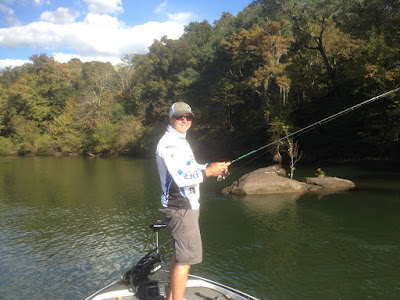
Took my Triton Boat up the rocky Flint River for shoal bass fishing
Boating on the rocky Flint River was a thrill ride but catching shoal bass was fun  

The Flint River holds a unique species of bass known as the Shoal Bass. This fish prefers to feed on crawfish in rocky rapids, and this stream is ranked as one of the more dangerous rocky streams.  Navigating my Triton fiberglass boat and Mercury ProXS over the shallow rocks took some careful driving.

The river has to be one of the most pristine rivers I have ever fished. Shoal bass are much smaller than their largemouth bass cousins, and fishing for them was only a backup plan.

Bassmaster bass fishing needs AERF biology for fishing tips and plant identifications
Aquatic plants are prime habitat for bass
The reservoir had been fishing extremely tough over the summer months and local tournament winners were reporting low historic weights. Hydrilla was dominating the lower end of the system, but nothing out of the ordinary could explain the low fish catch rates.

During my summertime practice on Lake Seminole, I was able to identify a lot of aquatic plants and catch some nice largemouth bass out of them.

Fishing pressure added to the difficult fishing conditions during the official practice week of the tournament, I had not ever witnessed so many local anglers on the water fishing during the work week as I did on Lake Seminole. The fishing pressure was over the top.

bass fishing and plant identification tips for bass fishing in Florida
Aquatic plants found on Lake Seminole (videos click here)
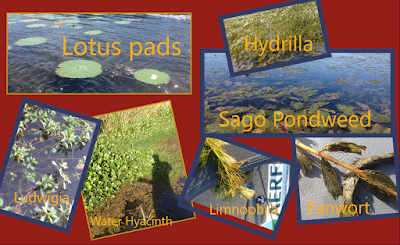
Flipping is always a strong fishing technique in plant filled lakes and I knew this method would dominate this event. Anglers could spend days flipping soft plastic baits into the large variety of floating plants and abundant submersed plants like hydrilla, coontail, sago pondweed, and fanwort. Flipping for days is exactly what I did in practice!

Click here to visit the UF IFAS video webpage and learn more about aquatic plants

Unfortunately I was only able to entice a bass or two per day to bite, I was not alone as my fellow competitors were also reporting low numbers of bites in practice.

I took the chance of not knowing whether the bites were from bass or mudfish since I didn't use hooks in practice, Hitchhiker screwrigs are a great lure invention for holding baits on fishing line with actually hooking fish. I felt I couldn't afford to hook the limited number of bass willing to eat with all the angler fishing pressure,

Roomates Jimmy Keith, Darrel Pons Sr, Paul Elias, and Shaw Grigsby Jr.
bass fishing with Triton Boat pros fishing florida
Here I sit between Jimmy and Darrel, along with Shaw Grigsby Jr and Charlie Hartley
This last tournament of the year was special for me as I was able to house with my good friends Shaw Grigsby Jr, Paul Elias, Darrel Pons Sr, and Jimmy Keith. These Elite pros and seasoned anglers have traveled the country, and it is fun to hang out with them.  Not to mention I always gain from their insight and experiences!

The camaraderie and friends you make on the tournament trail is another benefit to the Bassmaster orginization, whether it be the Bass Nation or Open trails.

The BASS organization encourages us to post photos and video during practice.  My practice experience was out shadowed by a few guys posting photos of giant bass ten to twelve pounds caught during the week. I was obviously out of touch with the fishing conditions.

Bass fishing on Lake Seminole learning plants and biology to catch fish
Anglers at Bainbridge GA ramp waiting for their launch numbers to be called

On the first day of the tournament I navigated my AERF-wrapped Triton Boat down the stump filled Flint River, to the lower end near the dam. I started off fishing a large hydrilla bed next to an open-water main lake channel where I had found bass in practice.

I noticed a small flurry of active bass first thing in the morning, and other than that it was a slow bite. I felt the trolling and outboard motor noises cutting through the grassbeds had probably kept the bass and baitfish on the move, and constantly alert them to angler presence.
biology of lake seminole offers different fishing tips for bass fishing
First bass of tournament was a nice five pound largemouth 
After flipping the grass for nearly an hour I switched baits and caught my first, and biggest bass, of the tournament. I  caught it working a spinnerbait over a hole in deep hydrilla, I was surprised the fish hit a powerbait when the fishing was so slow.  It made me believe the fish were suspended in the grass and would indeed hit a reaction bait. I alternated between the spinnerbait and flipping a black and blue creature bait all day. It was not a fancy or exciting way to fish, just required making thousands of flips into miles of hydrilla and coontail beds growing along the main river. My fishes areas in the lower end failed to give up anymore bass. For the last hour of the tournament, I ran up the Flint river to try and fill out a five-bass limit. Cranks baits produced some small bass, and while I managed to catch both largemouth and shoal bass in the event, they never weighed enough.

Video clip of day one weigh-in on Lake Seminole, by AERF
I ended up finishing in 92nd place, top 55%, a mere 7.9 pounds out of the top 40 cutoff.

******************************************************************

Insight Genesis maps help my bass fishing on my AERF Triton boat
Relaxing in the off season and reflecting on my tournament year
During my winter break from tournament competition, I relaxed in my home state of Florida while thinking back on my season.  My tournament record for 2015 was good, but not great.

I ended up 93rd in the Angler of the Year standings (out of 230 pros), equal to the top 45%.  I guess I am happy, given the high level of pro competition on the Bassmaster Open trail.

I was out of my comfort zone the entire time: fishing out-of-state lakes, practicing only two and a half days each event, angling for species of bass I rarely get a chance to catch, and competing against the best local anglers and Bassmaster Elite pros.

Yes, I got beat by a lot of anglers, but I equally beat some of the best local anglers and biggest names in the business. I experienced the core of tournament bass fishing, a sport that offers a roller coaster ride of emotions from highest of highs to lowest of lows. 

With 2015 behind me, I push forward into a new year with high hopes and renewed energy. My blog, website, and social media reached an all time peak in viewers and set the bar. Sharing information about fishing tips, bass and lake biology, and aquatic plant identification has become a second passion along with my tournament angling.  Each tournament situation is different, and I really enjoyed sharing the sights and stories through social media such as my Facebook, Twitter, YouTube, Instagram, and Pinterest,

AERF Mercury Marine Insight Genesis logos
Bassmaster Open photo by JO
Knowing aquatic plants allowed me to fish them better, and research on plants was supported by the Aquatic Ecosystem Restoration Foundation (AERF). I proudly wear their logo on my tournament jersey to help anglers learn about aquatic plants.

Additional support from Insight Genesis and GoFree Social Maps  really helped me maximize my Lowrance mapping features. Visit my website for links and upcoming how-to videos.

None of our recreational activities would be possible without our troops fighting to keep America free and safe. Please visit Kids In Support of Soldiers to learn how you can help them send monthly care packages to actively deployed soldiers defending our country.

Please check back with my blog monthly as I share new adventures and new fishing tips to make your fishing better and more enjoyable.

I hope you learned something new along with way! 
Thanks for following along,  Jeff Holland  
www.jeffhollandfishing.com

Thursday, June 4, 2015

The Lull in Between Events

What does a die hard angler do between tournaments to keep busy and focused?

I am finding myself with that delima and in an area of lull that is foreign to me. Basically, no planned tournament fishing. A storm is brewing in my head. 


The 2015 schedule for the Bassmaster Southern Open tour has a five month break over the summer.  I have enjoyed more family time than I can remember. Trip to California, to Hawaii, and a nice dinner at the German pub in Sanford, Fl. 


So far this year on the tournament trail I have struggled to make a check in the Bassmaster Opens. I didn't even place high enough to qualify for the BassFest extravaganza on Kentucky Lake. 

As I sit at home I happily support my roommate Shaw Grigsby, friend Paul Elias, and fellow angler Troy Boussard of Swamp People on their quest to win BassFest. 

When life takes us away from our goals we all need to embark on a "grounding", the process of going back to our roots, stoking up the flames of desire, and getting motivated to burn through the challenges life throws at you. 

I just celebrated my 28th year marriage anniversary with my wife Trish. We developed juvenile diabetes with our first child 28 years ago. I say "we" because we are a team and have to rely on each other for strength. 


Today, we enjoy three beautiful children, one angel, and a great son in law. My wife's diabetes and our fight to enjoy life has been a very inspirational and motivating experience. Her ability to push through the tough times and reap the rewards of hard work without complain makes me proud!!


The strength my wife shows as she endures against all odds makes me mad at today's lazy society that wants something from nothing. 


I love tournament bass fishing and I love to take on challenges, but is there more??  I believe there is. 


I want to recuperate and gain my mental strength that I seems to have withered. I know I can catch fish, I have proven it over four years in the Bassmaster Southern Open trail. Yet, I feel I need to take a moment to regroup. My famy and my career limit me to 2.5days of practice in my Open events. With such limited time against full-time pros and local experts, I fight an uphill battle to be the best. 


So, I am thinking about expanding my promotional ability to more anglers for my sponsor #AERF.  Surveys show for every high level tournament angler there are nine anglers fishing mid-level and club tournaments.  

I stand to gain a nine-fold increase in brand impressions by fishing the Florida Bass Nation trail and ABA Weekend Series as I regroup and fish in Florida for a while with my friends. That's a win-win deal!! 


During my mission to share aquatic plant education, my goal will be to qualify for the BASS National Championship through the Bass Nation schedule and earn a berth in the Bassmaster Classic.

During my sabbatical from the Opens, I intend to accrue the vacation time needed to balance family vacations with a full-time career as a  Pro Angler. 

Juggling family time against a full-time biology career and a parttime BasspPro associate career has been a hand full. 

If it works out that 2016 limits me to home waters, I look forward to being a local expert for awhile, then everyone else will have to compete against me! 

Soon, I will recharge and challenge my Elite tournament friends again! If I retire from my career anytime soon, I will look to be a threat against the Bassmaster pros full time!! 

Look out Shaw Grigsby, Gary Klein, and Paul Elias. I'm coming! 


....This is the rant of a die-hard bass angler....I hope you feel my struggle and share my enjoyment of competitive bass fishing. Don't forget to balance fishing with family. 

Jeff